
Why Launch Sites at the Equator Are Efficient for the Launch Vehicles?

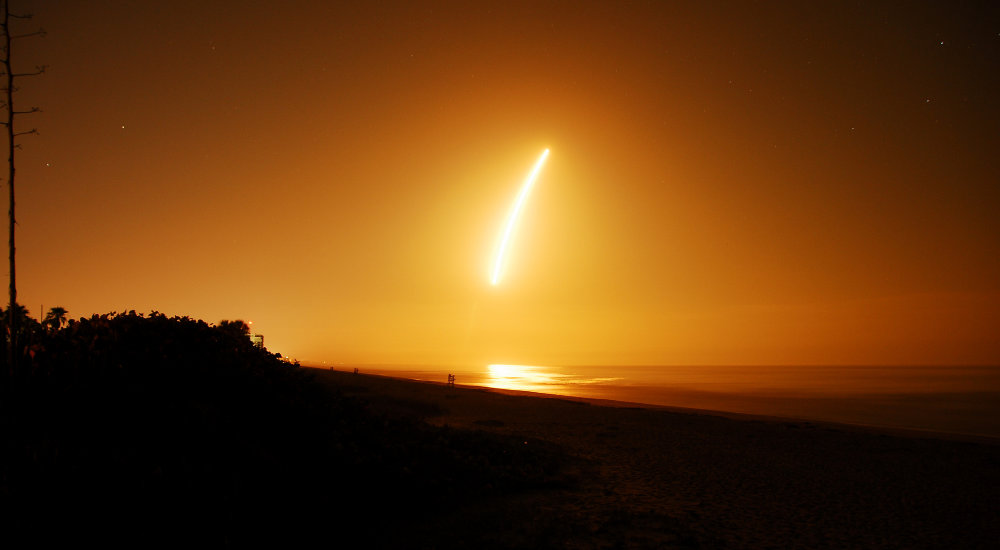
If you have a look at the distribution of the launch sites in a world map, you’d find that most of the launch sites are mostly constructed closer to the equator and in the eastern coast in most of the countries. Apart from various factors that decided the location of those sites, there is also a simple reason why they are built closer to the equator.
It’s all about speed
At the equator, the speed at which any point on the equatorial line moves, is faster than that of the speed of a point near the poles. Which simply means that the rotational speed of someone at the equator is faster than the rotational speed of a person standing at the poles, as the former would need to cover a larger distance than the latter who only needs to cover a smaller distance in one solar day (24 hours). The exact rotational speed of the person at the equator, where he have to travel 40,075Km (circumference of the earth at the equator) in 24 hours (solar day) is 463 m/s.
This 463 m/s speed adds up to any launch vehicle that is launched towards the east from the equator. Inertia ;) This speed boost cuts down the requirement of the amount fuel for attaining the 463m/s speed. This also helps the agencies to add more payloads with the same amount of fuel in the launch vehicle.
There are even mobile launch platforms that travel near the equator to launch several payloads. Sea launch is such a private spacecraft launch service that uses mobile launch platforms to launch spacecraft from any location near the equator.
One of the advantages of launching a satellite from the equator is that the satellite can be inclined to any required orbit from there with less propellant consumption. For geo-stationary satellites, the requirement of a plane change is eliminated and this means that more payloads can be added to the launch vehicle for the same cost.
On the contrary, to launch a satellite or a spacecraft into a polar orbit, the equatorial speed boost is undesirable and the launch vehicles are usually launched towards the west (opposite to the earth’s spin about its axis).
First published Oct 23, 2014.
We totally get why you have an ad blocker. If you enjoy reading Geekswipe, turning it off for us helps keep the site alive and the science coming.

Aeronautical engineer, product builder, developer, science fiction author, and an explorer. I'm the creator and editor of Geekswipe. I love writing about physics, aerospace, astronomy, and technology.
More by Karthikeyan KC



HAHAHAHA What bullshit!! Escape velocity is allegedly 17,000 mph, so why dont all air planes take off to the east?? I mean it would save so much fuel than taking off west, if true they would save the cash and take off east! Or does it only apply to rockets that initially take of vertically, before arcing slowly to the east, think about it, this is such BS! I assume you think the atmosphere is in lock with earths spin and it drags the planes and rockets around,
I played enough KSP to understand this.