Can Bubble Wrap Air Contain Contagions?

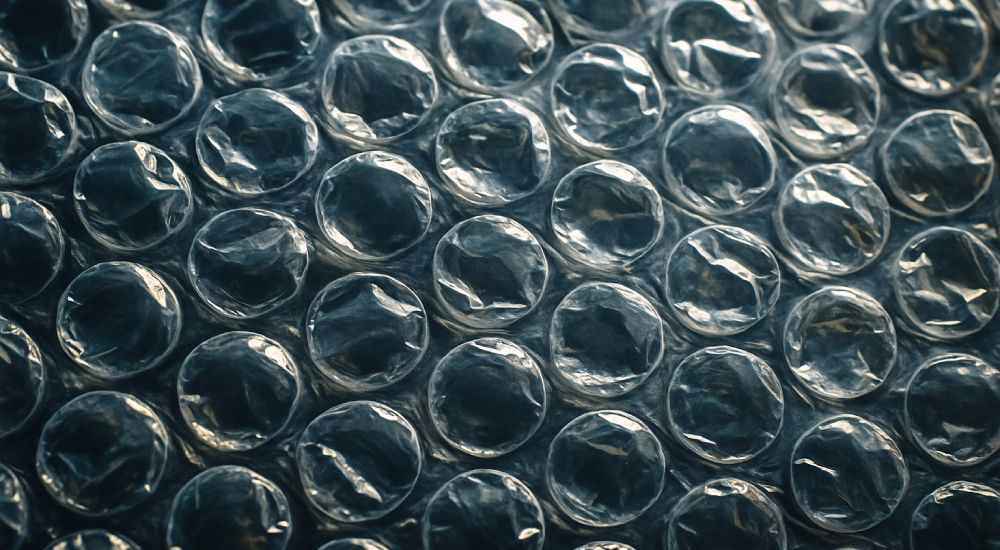
At first glance, bubble wrap seems like a harmless packing material that protects our fragile online purchases and tempts our fingers with an irresistible urge to pop our stress away. But here’s a question that might pop into your mind instead. Bubble wraps are made of … well … bubbles of air! So, could those bubbles of air contain contagions?
In a world still reeling from COVID-19, where fomite transmission (infection via surfaces) has been scrutinized more than ever, we need to rethink what materials might act as passive carriers of pathogens. In this edition, we’ll look closer into bubble wraps, their sealed pockets of air, and the plastic surface.
How are bubble wraps made?
Bubble wrap is typically made from low-density polyethylene (LDPE), a smooth, non-porous plastic. For a more detailed process, watch the following video from Sealed Air.
Could the bubble wrap’s surface become a fomite?
As made from LDPE, the surface does not easily absorb fluids, making it less hospitable to many bacteria and viruses. However, studies show that viruses like SARS-CoV-2 can survive on plastic surfaces for up to 3 days under certain conditions (van Doremalen et al., 2020).
That means if a contaminated person handles bubble wrap, coughs, sneezes, or touches it with unwashed hands, those germs can linger for some time. And since bubble wrap is often reused or stored for days in warehouses or homes, it becomes a low-key fomite.
What about the air inside the bubbles?
While imagining pathogens floating inside sealed plastic air pockets might seem exaggerated, the likelihood is extremely low. Manufacturing processes are highly automated, and clean air is injected into the bubbles during production. The seal is usually tight. Unless a bubble was somehow contaminated and resealed (unlikely), the internal air is not a concern.
Is it safe to pop bubble wrap?
However, popping a contaminated bubble wrap sheet could release small particles into the air, a process known as aerosolization. While no direct studies have tested pathogen spread via popping bubble wrap, aerosolized particles from surfaces are a known transmission vector in enclosed spaces (Asadi et al., 2020).
So theoretically, if the exterior is contaminated and you aggressively pop it indoors, you might release more than just fun. Remember, this is extremely unlikely though.
In practical terms, the risk of catching a disease from bubble wrap is extremely low. Most viral infections are spread through respiratory droplets or close contact. Still, if you’re handling bubble wrap that just arrived in the mail from an unknown source or a high-risk area, basic hygiene is smart: wash your hands after handling it and avoid popping until it’s been left untouched for at least three days.
While bubble wrap is unlikely to harbor infectious pathogens internally, its plastic surface can retain viruses for up to several days under ideal conditions. So, if you’re health-conscious or dealing with sensitive environments, treat it like any other surface. Clean hands, cautious handling, and educated popping parties.
References
- van Doremalen, N. et al. (2020). Aerosol and Surface Stability of SARS-CoV-2. New England Journal of Medicine. https://www.nejm.org/doi/full/10.1056/NEJMc2004973
- Asadi, S. et al. (2020). The coronavirus pandemic and aerosols: Does COVID-19 transmit via aerosol particles? Aerosol Science and Technology. https://pubmed.ncbi.nlm.nih.gov/32259197/
First published Aug 17, 2025.
We totally get why you have an ad blocker. If you enjoy reading Geekswipe, turning it off for us helps keep the site alive and the science coming.

Aeronautical engineer, product builder, developer, science fiction author, and an explorer. I'm the creator and editor of Geekswipe. I love writing about physics, aerospace, astronomy, and technology.
More by Karthikeyan KC