Future of Robotics is Squishy, Slimy, and Weird

Let’s be brutally honest for a second. The robotics industry has a massive ego problem.
If you look at the PR stunts from major tech companies over the last decade, especially from Boston Dynamics, they are obsessed with building bipedal, metal humanoids that can do backflips or awkwardly carry a box across a warehouse.
Why? Because we like to anthropomorphise things. We like to build machines in our own image, for most ‘robots’ that fit the definition.
But biologically (and functionally speaking), humans are a terrible design for most of the jobs we actually need robots to do. We’re top-heavy, rigid, and fragile! If you want a machine to navigate the crushing depths of the ocean, explore a collapsed building, or perform surgery inside a human lung, a metal skeleton is useless.
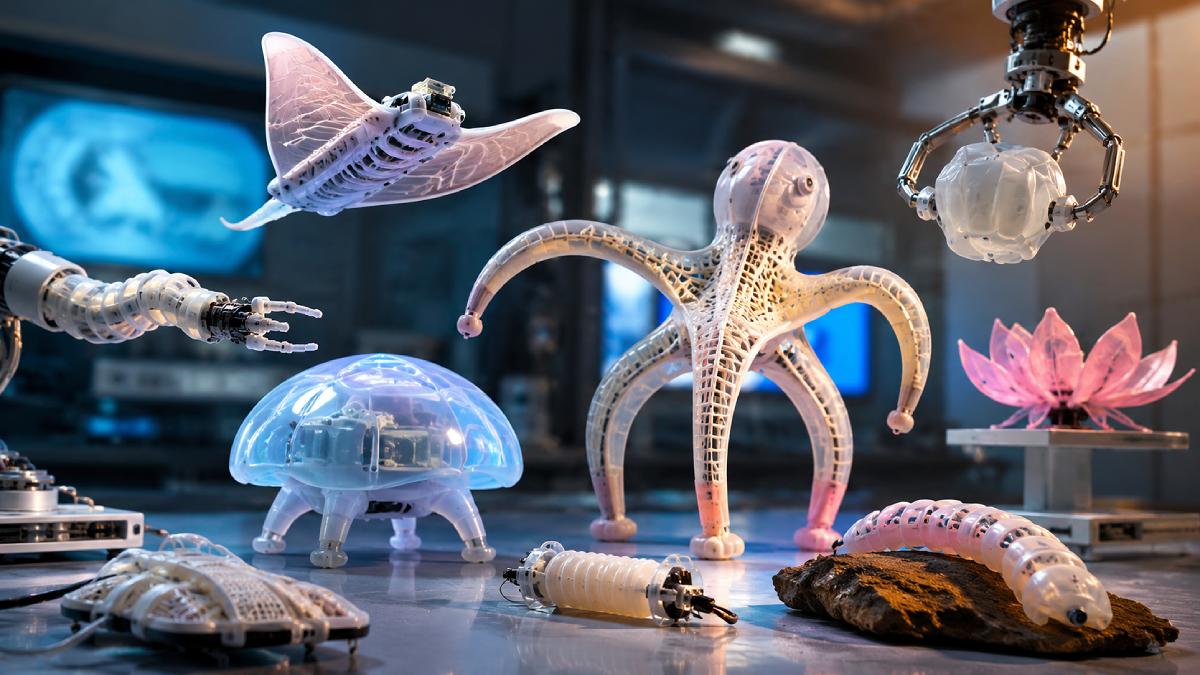
The real revolution in robotics isn’t happening in labs building iron terminators. It’s happening in labs studying jellyfish, octopuses, and slime.
Embodied intelligence featuring hydrostats
Most robotics engineers are trapped in the constraints of rigid mechanics. You have a motor, a joint, and a microchip. The microchip tells the motor to move the joint. This works great for narrower use cases like building cars on an assembly line, but it’s a nightmare in unstructured environments.
In nature if you see, things don’t overcomplicate our thinking when the body can do the heavy lifting. For example, you learn from interacting with the physical world rather than computing how much energy you need to exert to lift something with your mind. Technically, this concept is called embodied intelligence. For robots, it means the physical form and material properties of the robot essentially do the computing for it, interacting with the environment naturally, instead of relying on pre-determined code to calculate every single step.
Think about an octopus arm or an elephant’s trunk. It doesn’t have bones or rigid joints. It’s a muscular entity (a hydrostat), meaning the entire structure acts as both the skeleton and the muscle. It’s capable of infinite degrees of freedom to squeeze into anywhere. Try getting a metal humanoid arm to gracefully navigate a coral reef without destroying it. You can’t.
Areas where squishiness wins over clunky rigidity
Take underwater exploration for example. We currently use rigid, propeller-driven drones. They are loud, clunky, and highly disruptive to marine life.
Instead of forcing a human design into the water, researchers looked at the most efficient swimmer on earth — the jellyfish. By ditching heavy motors and instead using electrohydraulic actuators (basically small pouches of fluid that instantly zap into a specific shape when hit with an electrical current), they built a soft robot that mirrors a jellyfish bell.
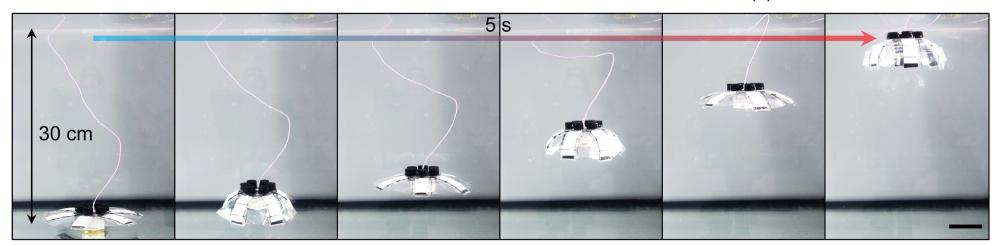
These jellyfish platforms are virtually silent, consume a ridiculously low amount of power (around 100 milliwatts), and can swim vertically while manipulating delicate objects without crushing them. If you want to monitor fragile ecosystems or retrieve data from the ocean floor, you don’t send a mechanical submarine. You send a synthetic jellyfish.
Can a squishy membrane actually do surgery?
Now let’s shrink the scale. One of the most terrifying places to deploy a robot is inside the human body. Traditional minimally invasive surgery still relies on rigid, tethered probes being inserted through your arteries. It’s effective, but it’s limited by its rigidity.
The future of medicine looks entirely different. Researchers are developing untethered soft grippers made of polymers and hydrogels (materials that mimic the actual squishiness of human tissue). These micro-robots don’t have onboard computers or batteries. They are completely autonomous and stimuli-responsive.
Wait, how? What does that mean?

You see, you simply inject these soft grippers into the bloodstream, guide them with an external magnetic field, and when they hit a specific physiological trigger, like a temperature or pH level of a tumour, they automatically respond to excise tissue or release a targeted drug. No wires. No rigid metal slicing through your organs. Just a piece of smart, shape-shifting jelly doing the job of a surgeon.
Is the future of tech basically just artificial slime?
Yes. And we should be thrilled about it!
Traditional rigid robots are brittle. Put them in an extreme environment with high pressure, wild temperature swings, or unpredictable impacts, and their mechanical joints snap. Soft robots, built from elastomers (basically an elastic polymer with a low Young’s modulus) and flexible composites, are practically immune to brittle fracture and can literally absorb impacts that would shatter a million-dollar rigid drone.
We are moving away from the era of “dumb” materials wrapped around “smart” chips. We are entering an era where the material is the machine.
So, the next time a tech company shows off a humanoid robot walking across a stage, don’t buy the hype. It’s an expensive parlour trick, a product aimed at the mass market that has little to no functional value. Like Alexa! The machines that will actually save your life, map the oceans, and navigate the ruins of our next natural disaster won’t look like us at all.
They’re going to be squishy.
First published Aug 17, 2012.
We totally get why you have an ad blocker. If you enjoy reading Geekswipe, turning it off for us helps keep the site alive and the science coming.

Aeronautical engineer, product builder, developer, science fiction author, and an explorer. I'm the creator and editor of Geekswipe. I love writing about physics, aerospace, astronomy, and technology.
More by Karthikeyan KC