
Is It Safe to Heat Food in Plastic?

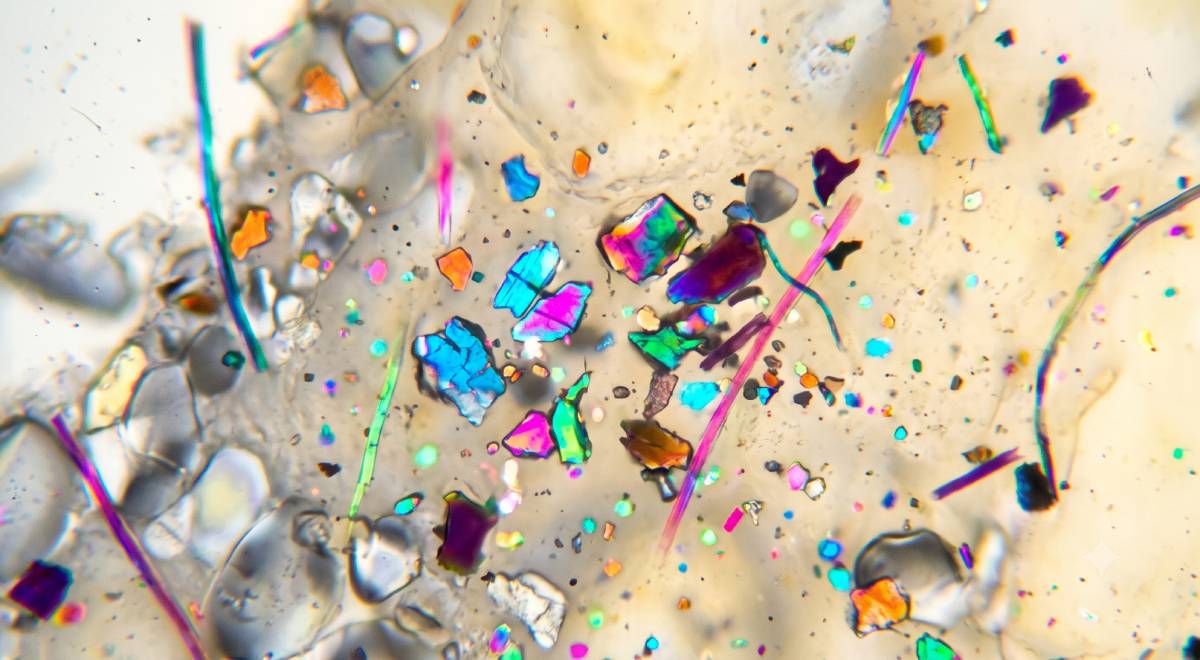
Heat, plastic, and food safety is always a never-ending debate, be it in the kitchen or at a lab. Let’s take a food-grade, microwave-safe polypropylene tub for example. When you microwave it, the container still releases millions of microplastics from every square centimetre into the food. But most don’t bother to question this because we have a label that says ‘microwave safe’ or ‘FDA approved’. And yeah, the Food and Drug Administration (FDA) does say that their current evidence doesn’t show a risk at the levels found in food. But can we trust them?
Knowing that FDA has a long list of controversies, where it has withheld safety information, caved in to lobbyists, allowed coal-tar based food dyes, and more that’s undocumented, it’s hard to just take their approval at face value. Now this is true for any government organisation. Be it the European Food Safety Authority or Food Safety and Standards Authority of India. And there are some agencies that do call out the risks. For example, cups or plates made of melamine with bamboo fibre in them release enough formaldehyde and melamine into hot food that the German Federal Institute for Risk Assessment (BfR) says “a risk to health arises” with daily use. Despite what they all claim, they’re organisations, and they’re all susceptible to corruption, mistakes, and delays in testing.
When it comes to health and safety, it’s up to us to go the extra mile with science to make sure things are actually safe. Validation and questioning don’t hurt, right? Especially when the question of safety comes to kids.
This Geekswipe edition answers all your burning questions about plastics, starting with the basics.
What does heat actually do to plastic?
A plastic is a polymer. Which means, it’s a long chain of one small molecule repeated thousands of times, with additives mixed in to make it soft, stable, or coloured. But they’re not perfect always. There’d be short leftover chains, or additives, or some unreacted ingredients, which can move out of the chain freely into another medium (like food or water). This movement is called migration. And plastics can also shed tiny bits of themselves. We call it microplastics. While there are many factors that can contribute to these, like physical friction, twisting, or even ageing, heat plays a primary role. The studies I mentioned before (Hussain et al., 2023 and BfR) show how microwaving released more particles than any other use tested and how kitchenware made of melamine with bamboo releases formaldehyde and melamine into the food.
Are all microplastics and nanoplastics harmful?
Some parts of the plastics like bisphenol-A (BPA) and phthalates are outright harmful. Some we don’t know yet. But in the end, whether any of it harms you comes down to three questions. Hazard, exposure, and risk. Think of a chilli. The “hazard” is how hot and spicy the chilli can be. The “exposure” is how much of it ends up in your food. The “risk” is whether your mouth actually burns, which needs both “hazard” and “exposure”. A ghost pepper sitting in the fridge is all hazard and no exposure. Or a glow-in-the-dark toy that’s in your child’s hand and not in the mouth is all hazard and no exposure too.
Here’s a nifty table to help you navigate around these questions for different kitchen materials.
| Material | What heat does? | Hazard | Exposure evidence | What regulators say | What to do? |
|---|---|---|---|---|---|
| Ready-meal film and tray | Reheated one-time containers can warp or melt and push chemicals into the food. | Chemicals migrating from the plastic, and particles. | Food safety information from United States Department of Agriculture (USDA). | USDA says don’t microwave one-time containers, and keep wrap off the food. | Follow the pack. Don’t reuse the tray, and keep wrap off the food. |
| Polypropylene (PP) or polyethylene (PE) cup or tub | As we discussed (Hussain et al., 2023), microwaving releases the most particles of any use tested, up to 4.22 million micro and 2.11 billion nano particles per cm² in 3 minutes. | Impacts reported on several organs at different levels of exposure to varying type, size, and amount. | The same study (Hussain et al., 2023) shows modelled intake up to 22.1 ng per kg of body weight a day for a toddler eating microwaved dairy from PP. | FDA says current evidence doesn’t show a risk at the levels found in food. | Heat in glass or microwave steel. |
| Non-stick (PTFE) pan | The coating can start to decompose from around 360 °C. | Overheating. PTFE itself is inert, but has some low risks. | Swallowed flakes from a scratched pan aren’t digested and leave unchanged. | BfR says never heat it empty and never at 360 °C or above. | Never preheat it empty on high. Replace it once in 3 years or if the food starts sticking. |
| Plastics in the dishwasher | Dishwashing increased leaching from reusable bottles, and 430 dishwasher-related compounds still migrated after an extra rinse. | Additives from the plastic, and dishwasher-related compounds. | The route into you is the next drink in that bottle. | No regulator guidance found. | Hand-wash plastic bottles and tubs if this bothers you. Glass and steel go in as normal. |
| Bamboo-melamine kids’ plate or cup | Releases even more formaldehyde and melamine than plain melamine (BfR). | Formaldehyde and melamine. | Formaldehyde from some bamboo cups worked out at 30 times the tolerable daily intake for adults and 120 times for toddlers (BfR). | BfR says don’t use it for hot drinks and meals. The UK says stop using it for food, and the EU treats it as unauthorised. No FDA statement. None from FSSAI as well. | Stop using it. |
What does ‘microwave safe’ actually mean?
It means the container won’t melt or deform to a certain temperature. It can still contain the harmful chemicals (unless an explicit label tells otherwise). So the label ‘microwave safe’ doesn’t automatically equate to ‘food safe’ on its own. FDA does provide regulatory direction to container manufacturers, but it’s just about how much temperature it can withstand and does it melt or deform in the microwave. Nothing about what sort of chemicals it leaches into the food. Those are two different worlds.
In a practical world, we might not avoid using a plastic container once in a while in the microwave. So let’s come back to Hussain et al., 2023’s study that found a lot of microplastics and nanoplastics released on heating. The FDA on the other hand says that the current evidence doesn’t show that the levels found in food pose a risk. Here, the lab counts and the FDA can both be right. Because the study’s claim is that particles killed 77% of human kidney cells at 1,000 µg per mL in a dish. Not through a dose from someone’s dinner.
In our chilli terms, there’s something in the pot and nobody knows how hot or spicy it is.
But the swap costs us nothing, though. Using a glass or ceramic mug (with no lead or paint). Interesting tidbit. Sometimes, if the bowl you are using is too smooth or the liquid (usually water) is too clean, you can superheat the water.
What happens to plastic in the dishwasher?
The Tisler and Christensen (2022) study tested water left for 24 hours in new reusable sports bottles, used ones, and freshly dishwashed ones. It found over 3,500 dishwasher-related compounds, and 430 still migrated into the water after an extra rinse. Dishwashing also increased leaching from the plastic itself, and the extra flush only halved it on average.
What about your glasses and steel pans in the same load? I couldn’t find a single study testing whether plastic additives transfer onto glass, ceramic, or steel in a dishwasher. But it’s fair to assume that it can.
Why did the UK and EU pull bamboo kids’ plates?
Because hot food that stays above 70 °C for minutes speeds up the plastic’s breakdown, especially in melamine dinnerware with bamboo fibres, leaching formaldehyde (which is a carcinogen) and melamine (causes kidney damage) into the food.
Melamine plates are generally moulded from melamine-formaldehyde resin, a hard plastic. The ‘bamboo’ versions mix ground bamboo into that resin. In 2019 the BfR pulled together official lab data from 2014 to 2019, covering 366 items tested for formaldehyde and 291 for melamine. On average the bamboo items released even more of both than plain melamine. Formaldehyde from some bamboo cups worked out at 30 times the tolerable daily intake for adults and 120 times for toddlers. For adults drinking coffee from one every day, or toddlers having hot milk or formula from one every day, the BfR’s wording is that “a risk to health arises”.
In other words, bamboo melamine is the one object where hazard, exposure, and risk all line up and scream red alert. It’s like a hot chilli and a big spoonful of it!
Europe acted on that. Ground bamboo isn’t on the EU’s list of substances allowed in food-contact plastics, so bamboo-filled plastic can’t legally be sold for food anywhere in the EU. In November 2022 the European Commission reported 748 cases across 21 countries, 644 on the market and 104 stopped at the border, trying to import bamboo based plastics. In July 2024 the UK’s food regulators, the Food Standards Agency and Food Standards Scotland, repeated their advice to stop using these items for food and told businesses to take them off sale.
The US and India are quieter. The FDA says not to microwave melamine dinnerware but nothing about bamboo. US shops still list kids’ plates sold as bamboo with a “food-grade melamine finish”. However, from a listing alone you can’t tell whether that’s bamboo fibre mixed into the resin, the kind Europe pulled. To err on caution, if the label says bamboo and melamine, just stop using it for hot food.
I found a dinnerware maker’s FAQ claiming that it’s perfectly safe to use melamine dinnerware as the hot food in their words “will actually cool to between 60 and 80ºC in just a few seconds”. I’m sure they’ve tested it on the right type of food with enough spread, to pass the regulatory standards, and passed the rest as a disclaimer to the customers to use it the ‘right’ way. But in reality, most don’t dive this deep into the risk of a colourful dinnerware they just bought at the store. If grandma finds a bowl, she pours all the porridge into it, and seconds change to minutes.
Here’s a quick idea to mathematically think about it. Stainless steel has a thermal conductivity k of 16. While melamine, k = 0.4. A terrible conductor of heat.
Let’s assume hot food sits on a melamine plate that starts at room temperature (22 °C). The food loses heat to the air from the top (convection), then to the plate at the bottom (conduction). If we treat food as water-like (dal or soup), here’s what an approximately modelled heat transfer flow using 1D transient heat conduction model shows.
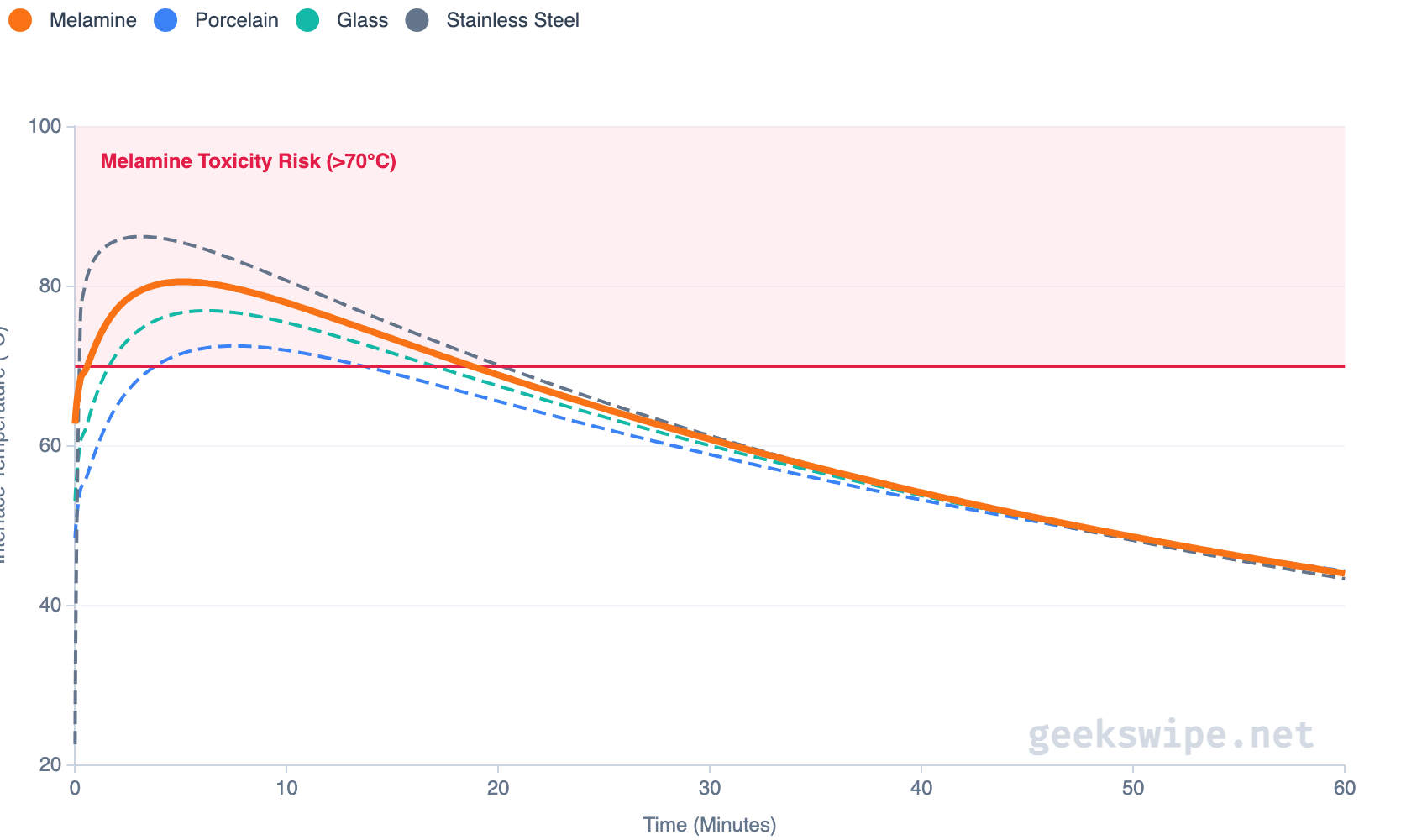
- The first few seconds. The manufacturer is right about these. Food at 95 °C on a cold melamine plate drops to about 68 °C where they touch, almost at once.
- The next few minutes. The plate is thin and the food holds far more heat. The plate being a poor conductor, refuses to absorb more heat. It rather starts acting as an insulator. For 250 g of dal or soup at 95 °C spread over 150 cm², the melamine surface climbs back to about 80 °C and stays above 70 °C for roughly 18 minutes.
- A toddler portion. 150 g at 90 °C over 120 cm², with a fair bit of steam coming off, stays above 70 °C for about 7 minutes.
The model leaves out heat spreading sideways into the plate’s rim, stirring, and imperfect contact, so a real plate may run a little cooler. But it still shows that “a few seconds” undersells how long the plate stays hot. It doesn’t show how much melamine ends up in the dinner. And I found no study measuring this. If you own a thermometer and a melamine plate, please do measure it and share it in the comments.
So, how worried should you be?
Put each measured exposure next to its own safety line. Formaldehyde from the worst bamboo cups sat 30 to 120 times over. Swallowed PTFE passes through undigested, so there’s no absorbed dose to compare. PP particles have no safety line yet, and the FDA says nobody has a validated method to measure them in food yet.
And for years of past use, the same three questions decide it. For most objects in the table, the evidence doesn’t show harm, or the stuff isn’t absorbed at all. The bamboo-melamine cup used daily for hot drinks is where it shifts drastically, which is why the BfR says to keep it away from hot drinks and meals.
If you’ve been using, or are planning to use, bamboo cups or containers that have melamine, you need to stay away from it. Use a glass or a stainless steel container.
References
- Food Safety and Inspection Service. (2011). Cooking safely in the microwave oven. U.S. Department of Agriculture. https://www.govinfo.gov/content/pkg/GOVPUB-A110-PURL-gpo127402/pdf/GOVPUB-A110-PURL-gpo127402.pdf
- Food Standards Scotland. (2024, July). Updated notice on plastic containers and utensils containing bamboo. https://www.foodstandards.gov.scot/news/updated-notice-on-plastic-containers-and-utensils-containing-bamboo
- German Federal Institute for Risk Assessment. (2019, November 25). Do not use ‘bamboo ware’ tableware for hot drinks and meals [Press release]. https://www.bfr.bund.de/en/press-release/do-not-use-bamboo-ware-tableware-for-hot-drinks-and-meals/
- German Federal Institute for Risk Assessment. (2025, February 7). Selected questions and answers on cookware, ovenware and frying pans with a non-stick coating made of PTFE. https://www.bfr.bund.de/en/service/frequently-asked-questions/topic/selected-questions-and-answers-on-cookware-ovenware-and-frying-pans-with-a-non-stick-coating-made-of-ptfe/
- Hussain, K. A., et al. (2023). Assessing the release of microplastics and nanoplastics from plastic containers and reusable food pouches: Implications for human health. Environmental Science & Technology, 57(26), 9782–9792. https://doi.org/10.1021/acs.est.3c01942
- Tisler, S., & Christensen, J. H. (2022). Non-target screening for the identification of migrating compounds from reusable plastic bottles into drinking water. Journal of Hazardous Materials. https://doi.org/10.1016/j.jhazmat.2022.128331
- U.S. Food and Drug Administration. (2007). Guidance for industry: Preparation of premarket submissions for food contact substances (chemistry recommendations). https://www.fda.gov/regulatory-information/search-fda-guidance-documents/guidance-industry-preparation-premarket-submissions-food-contact-substances-chemistry
- U.S. Food and Drug Administration. (2024, July 24). Microplastics and nanoplastics in foods. https://www.fda.gov/food/environmental-contaminants-food/microplastics-and-nanoplastics-foods
We totally get why you have an ad blocker. If you enjoy reading Geekswipe, turning it off for us helps keep the site alive and the science coming.

Aeronautical engineer, product builder, developer, science fiction author, and an explorer. I'm the creator and editor of Geekswipe. I love writing about physics, aerospace, astronomy, and technology.
More by Karthikeyan KC




My kids are very fond of bamboo plates. I don’t use it with hot food but I was concerned. This is very helpful. Thank you.