

Karthikeyan KC
Admin@karthikeyankc · Joined November 9, 2013
Aeronautical engineer, product builder, developer, science fiction author, and an explorer. I'm the creator and editor of Geekswipe. I love writing about physics, aerospace, astronomy, and technology.
7
Topics
126
Replies
Viewing 25 replies - 26 through 50 (of 126 total)

The waves are nothing but a physical vibration of air molecules. So when an object moves through the air, it interacts with the air molecules like how a boat or a submarine interacts with water.
In your case of a moving object, these air molecules get compressed in the direction in which the object moves. This is because the object has a velocity and this keeps pushing the air molecules as it moves. And like you said, the frequency of the waves will be higher at the front of the object. But at the opposite, the frequency of the waves will be lower as they are not packed up together (imagine the same boat and wave analogy). Yep! This is the doppler effect.
And in your second case of a stationary omnidirectional sound source and a stationary observer, the frequency of the sound will be constant in all the directions. Why? Because the object is stationary and it’s not compressing the sound waves in any direction. The sound waves have their original frequency. The volume at the observer’s end will be less audible as the amplitude of the sound wave is inversely proportional to the square of the distance – aka inverse square law.
And here is an interesting case! When the object starts travelling closer to the physical maximum limit of the molecules could travel (speed of sound), they keep stacking up together like a barrier. And when the object travels faster than this limit, it breaks that barrier and causes a sonic boom. Read more on how sonic boom works.
I play FPS, Battlefield mostly, from 8 PM to 10 PM. I have found that I play better right before dinner time. During that period, on CTF and rush rounds, I find myself aggressively focused, serious on the lead, and my reflexes are pretty good. After dinner, I just feel relaxed and unfocused. If I choose to play after a meal, I’d rather idle on a defensive line with support or recon class.
So it might be a placebo that makes my brain work more and focused on a reward – dinner. Also, as mentioned by @san, it could be the hunger hormones activating my brain to be more focused. So your guess is right. Mild hunger is likely to improve a gamer’s performance. But I cannot say the same for coding though. It’s the other way for it. Compared to coding, gaming doesn’t demand huge brainpower.
I understand where you are coming from.
Density is the mass of a substance per unit volume.
\(\rho = \frac{m}{V}\)
And you are right about the volume. The volume of water increases when it freezes due to its molecular structure. But as the mass is constant the ice becomes less dense when compared to liquid water. This is why ice floats on water.
But the sea levels do not rise when sea ice melts. Because they are formed in the sea and it’s just a phase change and no additional mass is added, hence no displacement.
It is the glacial ice and ice sheets that rise the sea levels when they melt—as they are not in the ocean in the first place. The glaciers and ice sheets are part of the continental land and when they melt and flow into the ocean, they add extra water—freshwater—into the ocean. This increases sea levels around the world.
In addition to this, as the Earth gets warmer, water itself expands thermally and contributes to the rise of ocean levels.
The ‘feel’ of gravity on a spaceship’s centrifuge (like that station you’d see in 2001: A Space Odyssey or Hermes from The Martian) is because of the centripetal force exerted by the centrifuge. Any occupants inside the centrifuge would then experience the centrifugal force, which they perceive as ‘gravity-like force’.
The reason why you see centrifuge concepts that has the longitudinal axis of the spaceship as its axis is could be attributed to convenience and convention.
In space, there’s no sense of any direction. Whichever way gravity pulls us, we call it ‘down’ and the opposite side as ‘up’.
For a spaceship, there are three primary axes and hence three possible configurations. For the following cases assume that the centrifuge is in operation as the spaceship accelerates.
- Centrifuge mounted in the usual way with its axis being the longitudinal axis of the spaceship.
- Centrifuge rotating around the lateral axis of the spaceship.
- Centrifuge around the ship, i.e, with the vertical/normal axis of the ship as its axis (your question’s case).
Case 1 – Longitudinal axis
In this case, we have a centrifuge like the Hermes. In the figure below, the axis of the centrifuge, the longitudinal axis of the ship, is passing out of the screen towards you.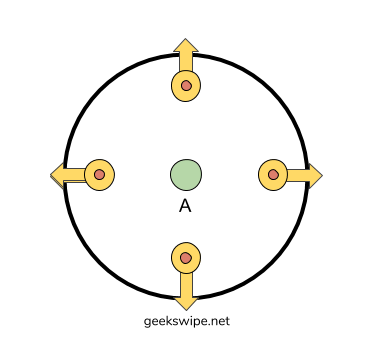
Here, we’d experience the ‘artificial gravity’ radially outward from the ship, as the walls of the centrifuge exert a centripetal force on the occupants.
And in this case, our ‘down’ is always facing away from the ship at all points. When you look ‘up’ you will always see the centre of the spaceship.
And if the whole ship needs accelerate temporarily by firing its thrusters, the occupants of the centrifuge, at any point, would feel an inertial force acting to their side and it won’t be affecting their ‘down’.
Case 2 – Lateral axis
In this case, consider the centrifuge to be mounted on either side of the spaceship as it rotates with the ship’s lateral axis as its axis. Think of it as a spaceship with two centrifuges (like wheels) on either side.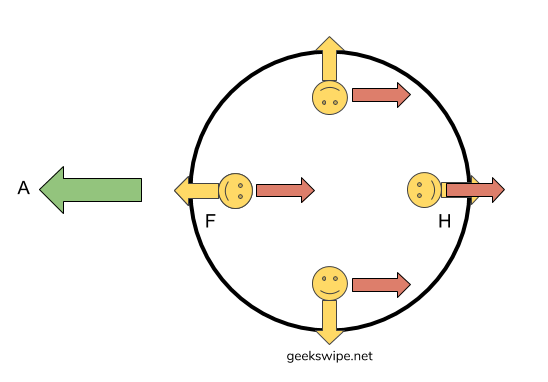
When the spaceship accelerates, at points F and H, you’d feel the inertial force pushing your feet and head. At F, you’d feel lighter and at H, you’d feel heavier. And as the centrifuge rotates, the direction of the inertial force changes and it would be uncomfortable than the previous configuration.
In other words, as the spaceship accelerates, your ‘down’ and ‘up’ are affected as the ∆v causes an inertial force that adds varies your inertial force perceived at F and H.
Case 3 – Normal axis
Like you’ve mentioned in the question, If the centrifuge runs around the spacecraft—with the normal axis of the ship as its axis, the experience would be similar to that of case 2, except in a different plane.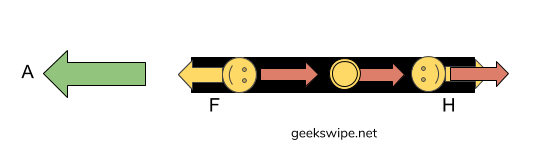
I guess this is one of the reasons why case 1 (longitudinal axis) is the preferred choice of configuration. But in any case, if the ship decides to fire the thrusters and accelerate, the centrifuge will be stopped, locked, and the crew will be asked to strap into their stations. In that scenario, the configuration doesn’t matter, as the only acceleration will be from the ship’s propulsion and you can orient yourself to it—which is also a type of ‘artificial gravity’.
I’d call case 1 as the safe choice for engineering reasons too. Configuring the centrifuge along the longitudinal axis doesn’t subject its walls to varied stress, unlike the other two configurations. In this type, the stress from the inertial forces are uniformly distributed, even when the centrifuge is in operation. Hence configuring it along the longitudinal axis eliminates or minimises structural failures during planned and unplanned acceleration events.
Case 1 is the winner! :)
At the ISS, it will most likely fall under the United Nations. If that is not the case, say if the judiciary situation involves a Russian and Japanese cosmonauts in an American module, the jurisdiction will fall under a united front of all the space agencies (Canadian Space Agency, ESA, JAXA, NASA, and Roscosmos) involved with the station. Or if just one module + crew is concerned with the situation, the country that owns it will exercise their jurisdiction.
Welcome to Geekswipe, @dan1000. Pretty interesting list here. Thanks.
Let’s get the basics straight and analyse stuff from there. Moon is a rock. A very big one indeed. For your story, you need that rock to fall on the Earth. Nice! I reckon that you want the moon to be in one piece too.
Moon is in a fairly circular orbit around the earth. It has an orbital velocity with a tangential and radial component. And To force the moon towards the earth you need to stop its linear momentum (p=mv — where m is the mass and v is the velocity). In other words, if you change the tangential velocity of the moon thereby changing the linear momentum, you can change its orbit.
Moon’s tangential velocity is roughly 3600 km/h. Mass is around 7.34×10²² kg. So if you apply a force over a time tangentially opposite, you can reduce the tangential velocity, thereby reducing the linear momentum.
And this force can be a small series of impacts applied for years—repeated asteroid, meteor, comet impacts. Or a quick one—a catastrophic impact from a huuuuge asteroid.
But impacts and collisions are tricky if you want the moon intact! The impact should have enough kinetic energy to reduce the momentum, but not too much to blast it into pieces—as an inelastic collision with kinetic energy higher than that of the moon’s gravitational binding energy will pulverize it.
So ideally the kinetic energy of the impactor should be below 3.6 x 1028 J. and should not exceed 1.2 x 1029 J (this is the gravitational binding energy of the moon). And you’d need a rock that’s equally big and dense as the moon—so you’d need an asteroid.
Similarly, if the impact was on the far side of the moon, it would increase the radial velocity component of the orbital velocity, which would then “shift” the orbit of the moon to an elliptic one—which would pass through the earth if the impact is large enough.
But the moon will probably be ripped off before it hits the earth anyway!
The physical effects after the impact
As you might know, a planet or a satellite in an elliptical orbit will have the fastest orbital speed at its perigee and the slowest at its apogee. This is due to conservation of angular momentum.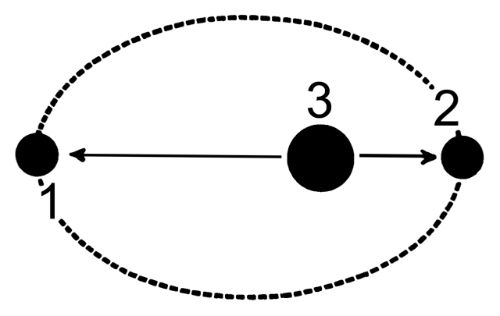
After the impact, when the moon’s orbit decays and it drifts inwards towards the earth, the physical effects of conservation of angular momentum becomes apparent. Contrary to your intuitive belief, the moon’s orbital speed would accelerate as a result of the smaller orbit and tidal forces imparted on it by the earth.
Oh, there’s more!
The moon is relatively tiny compared to earth. So when it’s close, the gravitational attraction of earth will impart even more brutal tidal forces on the moon, that when the moon gets around 9492 km (Roche limit), gravity will rip the moon into tiny chunks—causing an accretion disc around the earth. Now instead of one giant rock smashing your home, you’d be looking at millions of rock chunks smashing the earth.
But fear not! At this point, even before the moonlets hits the surface, the planet would suffer and die from other gravitational effects—tsunamis, earthquakes, volcanic activity—you get the gist!
You are right. When you put the pasta in water, the water molecules diffuse into pasta and expands it. The boiling medium is the hypotonic solution here; as the concentration of solutes is less in it compared to the cells of the pasta. Tonicity is a relative measure between two solutions, so any real world example would require two solutions with an osmotic gradient between them. In the pasta example, water is the hypotonic solution. And for the cells found in the fish gills, the salty seawater is a hypertonic solution.
I am oversimplifying this for the sake of explanation. According to relativity, any two observers in the universe who are in inertial frames must always agree about the speed of light. Always! Because it is proven to be constant in all conditions!
If you and your friend have two light clocks (A light clock measures time-based on the ticks of a light beam that’s bounced between two mirrors A and B) each and are on the ground, the time measured with those two clocks will be in sync. Of course! Because you both are in the same inertial frame and the time it takes for the light to bounced off the mirrors in your clocks will be the same.
But now let’s put you and your clock on a spaceship that can travel at half the speed of light. The spaceship now is travelling at 1/2 c and you are in it, watching the light beam bounce between A and B vertically. Everything is normal for you.
But when you fly past your friend, who is looking at you from the ground. He would see weird things happening in your clock. The light beams of your clock will not appear to travel vertically. He’d observe that the light beam in your clock takes a diagonal path (in the direction of the spaceship) as it bounces from B to A or A to B.
It is obvious that he observes it this way because the spaceship is moving too fast and the mirrors are moving along with the spaceship too. So the light’s path would be diagonal for ANY observer.
The light beam as it appears to take a diagonal path, it also appears that it has to take a longer distance to cover. Due to this longer distance, the light clock in motion now ticks slower. Therefore time in the spaceship appears to be slower for your friend. This is known as time dilation.
But for you, inside the spaceship, everything will be normal. And if you happen to observe your friend, it would appear that he is moving at 1/2 of c speed relative to you and you will observe his clock to be slower too.
Now let’s talk about ageing in the context of special relativity!
Say if you use that spaceship to travel to Proxima Centauri which is 4.2 light-years from Earth. You will be travelling at 1/2 the speed of light and it would take you 8.4 years to reach the star and another 8.4 years to come back to the Earth.
For you, the time passed is all normal – 8.4 back and forth, so 16.8 years of your life has passed. But on Earth, as time is relative, the people on Earth would’ve experienced a different time, that would have ticked faster than yours — and hence they would be a few years older than you.
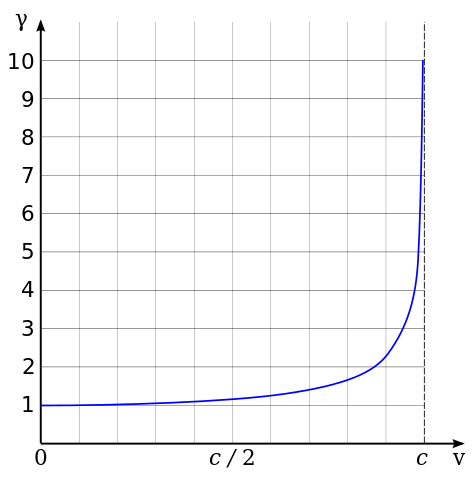
To have a significant change in the time delta, you’d need to be travelling above 75% of the speed of light.
Yes, it can. They can homogeneously change between one phase to the other at a particular temperature and pressure or exist as a. Thermodynamically, this particular temperature and pressure, at which a matter occur at all the three phases (solid, liquid, and gas), is known as the triple point. The following is the phase diagram of the water showing the triple point of water 273.16 K.
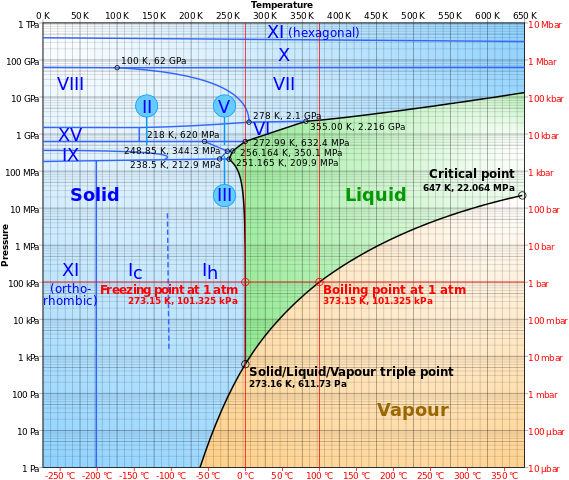
So at 273.16 K and 611.65 Pa, water exists as a homogenous mixture of solid, liquid, and gaseous phases, where any minimal changes to the temperature or pressure of the system can force a rapid transition between these phases.
Man! This film is a treasure. It’s got full of VFX stuff that blends in the right way.
I think she is referring to Dowsing.
After experimenting with <code> and <pre>, I don’t think it’s easy to escape it. I settled with using the HTML entity for the ` grave accent. Here you go! sudo kill `cat /var/run/mysqld/mysqld.pid`. Use <code> tags to wrap it instead of ` `.
Your friend’s observation makes sense. Take a look at the absorption spectra of chlorophyll.
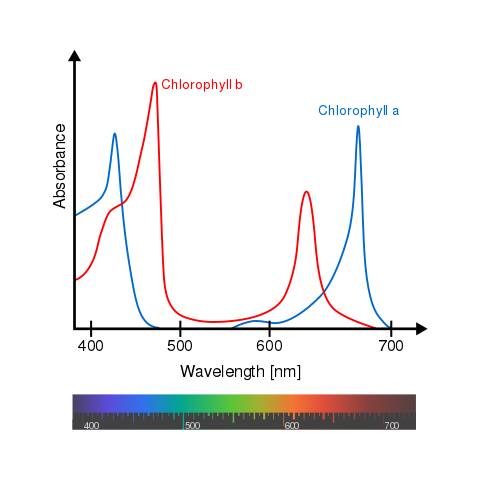
In the green range, the absorption rate is relatively low for the primary pigments chlorophyll b and chlorophyll a, which means the leaf reflects all the green light (the reason why plants appear green).
But in the violet and red ranges, the absorption peaks and chlorophyll benefit the most. And your 440 nm blue light happens to fall under that spectral range called the photosynthetically active radiation (400 to 500 nm and 600 to 700 nm – your optimal wavelength), which promotes photosynthesis in plants.
And to back your friend’s observation, here is a study on how the removal of green and near-UV radiation promotes plant and algae growth with visible improvements. Most of the plants have shown positive growth characteristics without the green light. For most of the plants, you could try it right from the germination phase.
But mind the fact that plants have other pigments that benefit from the green light too. Also, as the green light penetrates deep into the leaves than the red and the blue regions, it enables the chloroplasts that are away from the illuminated surface to promote photosynthesis. More on this, here and here.
To answer your first part of the question, the CO2 barely rises in our atmosphere. The second part of the question, not likely.
To a certain extent in our atmosphere called the turbopause layer, all gases exist as a homogenous mix of gases due to factors like turbulence from winds, thermal convection, and molecular diffusion. This region (homosphere) extends up to 100kms in our atmosphere to the turbopause. And within this region, the turbulence of the air dominates any stratification of gases.
Take helium for example. It exists in our atmosphere in trace amounts–as a homogenous mix along with oxygen, nitrogen, argon, carbon dioxide, and other molecules in trace amounts in the homosphere. Whenever you introduce helium at the surface of the Earth (not as helium balloons) the molecules would tend to rise, but collisions with the other molecules, and stronger turbulent currents, convection, all work stronger to keep helium close to the Earth.
But beyond the turbopause, the gases actually stratify based on their density. Hydrogen and helium, being the lightest would rise up. And for a gas molecule to leave the Earth’s atmosphere, it should require high kinetic energy and a longer mean free path (a huge space with no collisions happening) to overcome the escape velocity of the Earth. With the energy from the thermosphere and a large mean free path in the upper regions of the atmosphere, helium sometimes escapes Earth’s atmosphere.
Now back to carbon dioxide (and methane – even more potent than CO2). They are heavy. Compared to helium, a carbon dioxide molecule is approximately 14 times heavier than helium and methane 4 times.
As you see, methane would likely rise up than carbon dioxide. And when methane is oxidized in the troposphere, carbon dioxide is released along with water vapour. And for the CO2 molecule to blast off into space, it would require 14 times the energy of helium. And if the CO2 gains kinetic energy (14 times the energy required for helium), it would blast off into space. Or the solar storms would strip them away.
I don’t think you can just update the emoji set alone. It’s part of the feature updates.
You’re welcome! :) And actually, this seems better! With an FTP client like Filezilla running on the PC, I can keep select folders in sync with the phone too. Especially my music library! Yay! You could try HTTP too! Should get interesting when you start running a server from your phone.
You can do that with FTP or SMB. You’ll need to set up an FTP server or enable file sharing on your computer to the folders you would like to share. And then you can access it from your Android with any FTP/SMB clients available from the app store. I’ve used AndSMB client and it does the job! Here is an updated overview on this.
Hello Durran,
Interesting question.
The short answer for this is buoyancy.
Long answer:
When the flask and the balloon setup is placed, it is inside a fluid (air) medium. And as it occupies a certain volume, the setup would experience a buoyant force. (If the density of the whole setup is less (hypothetically) than that of the air, it will float way, of course. But in reality, the density is high, and so it sinks.) Now when the baking soda and vinegar in the flask reacts, the gas inflates the balloon. This increases the volume of the whole system, which makes it less dense compared to the previous state. As the density decreases, the buoyant force on it increases a bit, making it to weigh lighter than before.
The law of conservation of mass is not violated here as the total mass remains the same, while the weight (mass × acceleration due to gravity) of the system is the one that changes.
Hope it helps! :)
Most games—the majority of free MMO games—are pay 2 win sadly. From the top of my mind, DOTA 2 is currently a free, play 2 win MMO that I played some time ago. You only need to pay for the cosmetic stuff. But then there is DOTA plus. But honestly, even the paid games are turning into pay 2 win these days with all that shortcut kits and other loot box craps. It’s a sad state of gaming today. So to answer your question, there are no online games these days that would qualify as a truly skill based play to win!
You’re right. A rocket with enough fuel in it would eventually leave the Earth’s gravitational field, even if the velocity is less than the escape velocity. This is because the rocket’s engine is propelling it constantly with enough thrust to counter the effects of the gravitational pull.
In the other hand, escape velocity is the initial minimum speed threshold required for an object thrown or launched upwards from the surface of the Earth so that the projectile would leave the gravitational field without the need for any propulsion or work. So if you were to launch a rocket at 11.2 km/s, it can theoretically leave the gravitational field of the Earth without any further thrust from the engine. The concept of escape velocity usually applies to projectiles (objects that are not powered).
Hello Javy,
Welcome to Geekswipe Curiosity. When NaCl dissolves in water to form Na+ and Cl-, depending on the ions that are already in the water medium, there would be a lot of possibilities for the two ions to bond with other counterions to become neutral again. At room temperature and pressure, most of such reactions would be soluble in water for Na+ and Cl-. However, Lead ion and chloride ion for example, would result in a partially soluble precipitate of lead chloride. And silver ion with chloride ion would result in an insoluble precipitate. You can refer this solubility chart for all possible reactions.
When light is incident on the photosystem II, the electrons in the chloroplast molecules are excited. And when this energy is transferred to the reaction centre (via resonant energy), the electron acceptors remove the excited electron from the (special pair) chlorophyll and initiates the electron transport chain process.
Also, due to photolysis, the water molecules are split into O2 atoms and H2+ ions. The electrons lost by the chlorophyll pigments in the photosystem II is replaced by these electrons lost (by the H2 atoms) in the splitting of the water. The H2+ ions then form the hydrogen ion gradient coupled with the electron chain, whereas the O2 atoms combine to form oxygen molecule that is released as a by-product.
Further down the electron transfer chain, the electrons from photosystem II reaches photosystem I and is accepted by the already electron deficit chlorophyll molecules (The photosystem I would also lose electrons the same was like photosystem II) in the reaction centre of photosystem I. The lost electrons from photosystem I will go into making NADPH, further leading to create ATP.
So to answer your question, the electrons come from a) excitation of electrons in the photosystem II reaction centre, b) splitting of water molecules due to photolysis, c) excitation of electrons in the photosystem I reaction centre.
Hi Jamie. The sea level mainly raises due to ice from land getting mixed up in the sea. For example, at Antarctica, the ice sheets are a part of the land mass and not the sea. Due to global warming, this ice sheets break off and run into the ocean, thereby displacing water equal to its mass (Archimedes principle). This is what causes the ocean levels to raise primarily.
Now let’s take a look at the icebergs that are already in the ocean. When these icebergs melt they shouldn’t displace any more of the water they had already displaced. This is only true when the water from the ice has the same concentration as of the sea water.
But if the icebergs are made up of fresh water, a different process happens. The sea water is a little denser when compared to the fresh water. So when the fresh water mixes up in the ocean, it takes a little more volume than its frozen form, thus raising the ocean levels slightly.
Minimalistic! Nice one. For me, it’s all pandas these days! This is my current wallpaper!

Viewing 25 replies - 26 through 50 (of 126 total)