
What Happens to Water in Space/Vacuum?

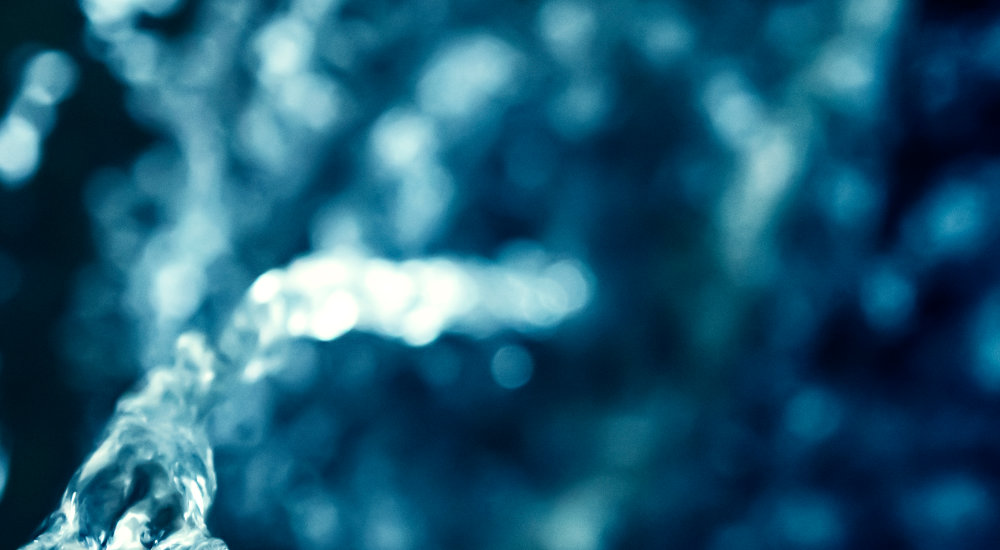
Not many of us have had the opportunity to put water in a vacuum chamber and observe what happens to it. So we are going to take you along with our exploration and show you what happens to the water, as you expose it to the vacuum, or more generally, the outer space. (Which is not a perfect vacuum anyway!)
Water at sea level
When the water is at sea level, it is exposed to the standard atmospheric pressure and temperature (1 atm and 0 °C), where it vaporizes gradually (evaporates), just like the rest of the water in the world. But when you start adding heat to boil it, the water vaporizes faster (boils) as soon as it reaches the boiling point, and continues to vaporize at that rate until the temperature drops below the boiling point, i.e. you remove the heat source.
Boiling point
The water boils the moment when the vapor pressure that builds up above the water surface, becomes equal to the atmospheric pressure. The temperature at which this happens is the boiling point of the water, and at sea level, it is 100 °C. This boiling point can be decreased for any liquids by boiling them at lower atmospheric pressures. Now with this knowledge, we can explain what happens if we increase the altitude.
Water at the Everest
Before we launch ourselves straight into space, let’s try putting our water beaker on the Everest and explore the changes in it. The top point of the Everest is 8848 meters above the sea level, and at this height, the atmospheric pressure is 0.34 atm, which is lower than that of the sea level, which is 1 atm.
When you boil any liquid in such lower pressure, the temperature required to attain the equilibrium vapor pressure is much lower. This reduces the boiling point of the liquid.
In the case of water here, the boiling point would be lower too. As the atmospheric pressure is less at the Everest, the pressure exerted on the surface of the water would be less and the vapor pressure required for the equilibrium condition would be less too. The equilibrium vapor pressure is attained at 71 °C and the water starts boiling, as you heat it to the same temperature.
Water in vacuum or space
So now, we are in a spaceship with your beaker of water, waiting to be released into the dark and cold vacuum. The minimum temperature of the space is about 2.7 K or -270.45 °C (energy radiated by cosmic background radiation), which is a little above the absolute zero (0 K or -273.15 °C). The pressure will be negligible.
Now, we eject the beaker into the void. As it floats, the water inside the beaker boils instantly. The instantaneous boiling occurs, as the boiling point of the water is too low due to the negligible pressure in space. As the water vaporizes using the heat energy from the rest of the liquid water, the temperature of the water also reduces to the point where the rest of the water freezes. Besides this, the lower temperature of the vacuum also freezes (deposition) the water vapor, turning them into solid crystals. What left in the beaker will be solid ice. So when you expose water into space or vacuum, both boiling and freezing occurs.
Thought the space ride wasn’t that dramatic, I hope you learned something today. Send all your follow-up questions and discussion points to us either via the discussion box below or via our contact form. We would be happy to answer your questions and further explore with you.
First published Dec 27, 2014.
We totally get why you have an ad blocker. If you enjoy reading Geekswipe, turning it off for us helps keep the site alive and the science coming.

Aeronautical engineer, product builder, developer, science fiction author, and an explorer. I'm the creator and editor of Geekswipe. I love writing about physics, aerospace, astronomy, and technology.
More by Karthikeyan KC


Great article but I have to add that we do have the ability to achieve UHV on earth, and yet still control the temperature within the chamber. This would allow you to isolate the effects of the vacuum of space from the temperature of space. And what would happen with the water at a pressure of 1E-7 Torr at 23C would be a great addition to your article.
quote ‘As the water vaporizes using the heat energy from the rest of the liquid water, the temperature of the water also reduces to the point where the rest of the water freezes.’ == is this true at normal temp? Surface layer evaporation uses heat from lower body of water, reducing its temperature. Is that why skate rinks use hot water not cold to repair ice, because it freezes more quickly? (they say).
We associate boiling water as hot water however when the water boils in space is the water hot or not?
Hot is a relative term at best. If the water boils at a temperature you consider hot, then it would be hot. If it boils at a temperature you would consider warm, it would be warm. If it boils at a temperature you consider cold, it would be cold… The boiling point of Acetylene is -84C. Is that hot just because it’s the boiling point? The answer is of course no.
Great response.
It is a very good explanation. If we create a space under vacuum with a vacuum pump and water to be poured down drop wise in the vacuum space created by vacuum pump what will happen? Please explain.
The ‘creating a vacuum under a vacuum’ would still be a vacuum. Unless these two vacuums are separated by a conduit of air medium, the whole system would be a vacuum and the water would still undergo the same process – boil and freeze. And if there is a conduit, and you were to suck the frozen ice crystals through it and feed it back into the second vacuum, the heat would melt the ice in the conduit to water, and when it enters the second vacuum, the water would instantly boil and then freeze back.
if you throw a cube if ice into space, what happens to it? whats the difference if inside a spaceship ?
If there’s no other source of radiation, the ice would stay in its stable form. But due to other radiation sources in space, the ice would eventually sublimate to the vapour phase. As for your second question, the spaceship is a controlled environment. So the ice would be reacting to the appropriate conditions inside the ship.
The framework that both of you began to elucidate in such comprehensible manner is exciting yet. However, one important issue is if the divers can scape from the freezing at least while they use his reserves of air (Suppose that each diver can hold his breathe at a range between 1 and 4 minutes) thus allowing an imaginary “rescue margin”. It would be great to model how the entire process would look like; not only matter to know the final picture that is the total freezing of the system. By process, I mean that is difficult for us providing answers yet about the intermediate stages. It would be exciting to watch if the scenario we have considered previously is in fact the opposite of the real situation.
By this I mean that in vacuum there are no particles (e.g. dust particles) on which to anchor water molecules in order to start the nucleation process. In absence of such kind of nucleators the ice formation process will only occur in the layers beyond −40 °C (233 K). With reference to the crust forming there are considerations for the outer layers which are in direct contact with temperature of the outer space (near -270 °C). We do not know as yet how much time takes the crust formation, so we do not know if for some time period the water only continues boiling at the surface while ice crystals are ejected in a “mini snow”. By the contrary, an alternative scenario can occur at the core of the system, because the crystal growth is possible there whereas the water molecules can find surfaces —human bodies— that can be used for adhesion at temperatures between 0 °C and -39 °Celsius. It made me wonder: Did the ice will be formed first upon the divers while the surface of the mass of water only is boiling? So, I wonder if in the simulation of the system could actually happen an “ice-forming battle” between the boundary of the mass of water (the “ice-crust” model) and the core of the system (the model of nucleating divers). May be there are key issues that are still unresolved in order to know if these are simultaneous models or if any of both wins the “battle” of freezing.
You are mostly correct about the ‘human’ part inside the water. It does affect the rate of freezing (human = nucleation site). But as most of the freezing happens due to the extremely low pressure and not because of the temperature, it is worth to note that the process will more or less be the same for any mass of water, as the intense vacuum will boil the water and suck out all the gas first (including the gas from the divers lungs). With the human inside, this will be much easier as the diver serves as a nucleation site. Now the temperature comes into play and seals the surface with ice (radiation) and then the entire water body instantly freezes anyway. In case, the diver bubbles out during this phase change, the bubble would de-sublimate (deposition). Though you can argue about the heat from the divers, it will be conducted through the water and then radiated for sure. But no battle, though. :)
The situation becomes almost crystal clear now @K@KarthikeyanKC:disqus. I realize now about the number of parameters involved with the scenario, but even though I keep in mind a big picture of the freezing process I still can not realize if it happens in only seconds or it takes some minutes, giving a chance that they can be rescued. For instance, Is there any chance that the divers can stay alive at least two or three minutes? How about if the divers can retain the air for a couple of minutes? and, For how long can the remainings of liquid water be found in the system? I am thinking about the impact that may have the large quantities of water that we are considering.
To answer that question, the rate would be proportional to the volume, just as on earth. You put two different volumes of water in the freezer. The lowest volume would freeze faster. The thermodynamics (excluding the type of ice) is the one varies in the space.
Hi @@KarthikeyanKC:disqus, I want to thank you for the opportunity to discuss about this subject and the chance to clear up some of the doubts as they arose. I would be happy to discuss another subjects through more private electronic means; over email if you prefer or even via the Facebook inbox if you have an account.
I am in the process of writing a fiction text with a view to develop a film script in the near future. Best regards and thank you again for all.
You are welcome. The pleasure is mine as well :) I’m looking forward to another interesting discussion too. Sent you a request on facebook. I wish you all the very best for your fiction.
Hi @@KarthikeyanKC:disqus and @grah@grahambkey89:disqus. I have a number of ideas to share with you.
Hi @kaKarthikeyan KC and @graGraham.
The framework that both of you began to elucidate in such comprehensible manner is exciting yet. However, one important issue is if the divers can scape from the freezing at least while they use his reserves of air (Suppose that each diver can hold his breathe at a range between 1 and 4 minutes) thus allowing an imaginary “rescue margin”. It would be great to model how the entire process would look like; ; not only matter to know the final picture that is the total freezing of the system. By process, I mean that is difficult for us providing answers yet about the intermediate stages. It would be exciting to watch if the scenario we have considered previously is in fact the opposite of the real situation.
By this I mean that in vacuum there are no particles (e.g. dust particles) on which to anchor water molecules in order to start the nucleation process. In absence of such kind of nucleators the ice formation process will only occur in the layers beyond −40 °C (233 K). With reference to the crust forming there are considerations for the outer layers which are in direct contact with temperature of the outer space (near -270 °C). We do not know as yet how much time takes the crust formation, so we do not know if for some time period the water only continues boiling at the surface while ice crystals are ejected in a “mini snow”. By the contrary, an alternative scenario can occur at the core of the system, because the crystal growth is possible there whereas the water molecules can find surfaces —human bodies— that can be used for adhesion at temperatures between 0 °C and -39 °Celsius. It made me wonder: Did the ice will be formed first upon the divers while the surface of the mass of water only is boiling? So, I wonder if in the simulation of the system could actually happen an “ice-forming battle” between the boundary of the mass of water (the “ice-crust” model) and the core of the system (the model of nucleating divers). May be there are key issues that are still unresolved in order to know if these are simultaneous models or if any of both wins the “battle” of freezing.
Hi. I would like to know if it would be the same scenario with large amounts of water. I am imagining a huge space ship during an interplanetary travel. Assume that is moving in the vacuum of the space with one of his chambers totally filled with 30.000 galloons of fresh water. Let me also assume that suddenly some astronauts decide to do scuba diving in the middle of the mass of water. Then a terrible accident occurs: the pressurized chamber opens and all is ejected to the vacuum. My question is if it might be possible that the surface of the ejected mass of water can form a frozen crust able to maintain the divers alive in a bubble of liquid water, at least while they can hold their breaths.
When the water boils due to the instant vacuum, it reduces the temperature of the rest of the water. This obviously freezes the whole water mass, turning it into ice and the vapor into crystals of ice. Therefore, no liquid water. :)
But if the water mass is as large as you have mentioned, the system could get little complicated as the boiling might affect the rest of the layers and slow down the process at the core. It might even form a tiny atmosphere at the very beginning. However, without any experiments, these systems are hard to understand.
You are right, it is hard to understand. However I would like so much to have some “visual” of the real scenario, to get an idea of the behavior of things. Maybe it will be good to do a simulation in the light of the lack of more accurate empirical data, don’t you think? Do you know anyone who may be able to help us, someone interested in bridging the gap of data? Unfortunately I do not have the background or the education to go further with software like MatLab (I am an Industrial Designer and fiction writer). On the other hand the lack of data can be positive as this opens the way in order to obtain new answers that should be all the more surprising.
Perfect timing Carlos :) Ever Since you asked the question, I’ve been searching for such models online. My initial thought was to run a simulation too. However, the model is far beyond my knowledge of simulations. I know some FLUENT. But as you’ve mentioned, I guess with some basic data and a professional help, the model could be visually explored. Let me check with my friends and update you soon. I’m more excited now.
¡Bravo! That is excellent Karthikeyan KC. It is for sure that it will be a wonderful subject to close this year in a rewarding way. If you need any 3D CAD model for the simulation (e.g: the scuba diver astronaut, the water filled module…) please let me know.
Sure :) I appreciate your help. I have downloaded a few resources to check if this can be done (as we are dealing with a multiphase flow+near vacuum here). I will let you know soon Carlos.
It is not that hard. The same effect will be observed. Just like the small amount of water, the large volume will begin to boil from all the contours making its way down to the core where the scuba divers are swimming. The internal energy of the water will decrease and hence the freezing. The heat from the system (including the scuba divers) will be radiated away into space. This justifies that the same effect will be observed regardless of volume or the rate of change. A model would only show you the rate of change whatsoever.
Yes. Technically, the latent heat of vaporization is lowered in this, which makes the vaporization easy. @carlosalbertoavendaorestrepo:disqus, I guess this answers our question. The vaporization happens quickly and the water body would change phase anyway. If there are any bubbles formed inside, say like the scuba divers, the gas wouldn’t have much time to leave the body and hence my ‘mini snow’ theory (the phase diagram).:) However, @grahambkey89:disqus, your statement about the volume is confusing. When the latent heat is reduced, not all the water would vaporize. The volume of the water has a great impact on the freezing of the rest of the water due to radiation. Also, as Carlos mentioned, there is a scuba diver inside the water body, whose heat is conducted to the water too. So the rate of freezing actually will be slower than a normal body of water. A CFD simulation, even with approximated data would prove the same.
thanks for clarifying. I’m sorry about the volume interpretation.
Hi. I would like to know if it would be the same scenario with large amounts of water. I am imagining a huge space ship during an interplanetary travel. Assume that is moving in the vacuum of the space with one of his chambers totally filled with 30.000 galloons of fresh water. Let me also assume that suddenly some astronauts decide to do scuba diving in the middle of the mass of water. Then a terrible accident occurs: the pressurized chamber opens and all is ejected to the vacuum. My question is if it might be possible that the surface of the ejected mass of water can form a frozen crust able to maintain the divers alive in a bubble of liquid water, at least while they can hold their breaths?
Try throwing hot boiling water in freezing air. We did it when it was below zero in Montreal (lethal cold) that even our pee turned snowing..!