
How to Make Fuel From Air?

At first, it reads like a scam. Yeah I too got the same vibes. But what if the recipe for a clean fuel is just water, wind, and the air around? Would that even work?
Turns out, a small British firm has actually cracked the code on a game-changing technology that synthesises petrol from nothing but carbon dioxide and water vapour. Based in Stockton-on-Tees (yep, that’s a town’s name), the team at Air Fuel Synthesis has already extracted up to five litres of petrol since August, proving their clever new refinery process works in the real world.
It sounds like modern alchemy, but it is actually happening right now. Let’s look at how these ‘e-fuels’ actually work.
Steps to harvest fuel from air
To get how we make fuel from the sky, we kind of have to remember what fuel is in the first place. Whether we are talking about the petrol in your car or jet fuel, they are all just hydrocarbons. And as the name suggests, a hydrocarbon is just a chain made of two building blocks, which is hydrogen and carbon respectively.
Think of them like Legos. For over a century, we’ve just been digging these pre-assembled Lego chains out of the ground as crude oil. But if we know the recipe is just hydrogen and carbon, why wait millions of years for the planet to cook it up? We can just find our own Lego bricks and snap them together. Right?
Well, here is that DIY recipe to make your own petrol from air.
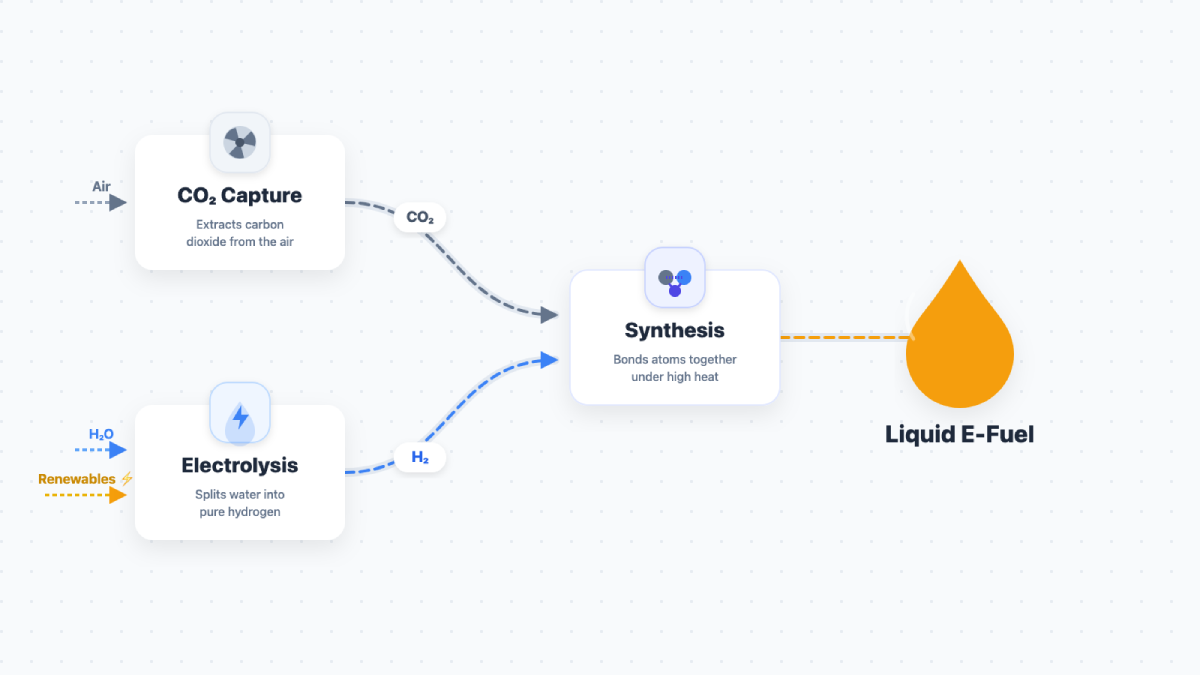
Step 1: Harvest carbon
We need carbon. And where is there a ton of it just floating around? The atmosphere!
Every time we exhale or a power plant burns coal, carbon dioxide (CO2) goes up into the air. To keep the air free of CO2, engineers use something called Direct Air Capture to capture it and store it underground. They build these massive fans that suck in regular air and push it over special chemical filters. The filters act like sponges that only trap CO2 molecules and let the rest of the air pass through.
Once the sponge is totally full, they heat it up, release the pure CO2, and trap it in a tank. Now we’ve got our carbon.
Step 2: Harvest hydrogen
Now we need hydrogen. The easiest place to find it is water (H2O). It’s literally two hydrogens attached to an oxygen.
The problem is that water molecules are pretty happy as they are. They do not really want to break apart. To force them to separate, we use a process called electrolysis. Basically, you take purified water and blast it with a ridiculous amount of electricity. This shock rips the water molecules apart. The oxygen just vents back into the atmosphere, which is fine. We love oxygen, don’t we? The pure hydrogen gas gets captured.
But for this whole process of hydrogen extraction to be actually green, the massive amounts of electricity absolutely has to come from renewable sources like solar or wind. If we use a coal plant to make clean fuel, we’d be completely missing the point here.
Step 3: Bond carbon and hydrogen
So we have our carbon and our hydrogen. Time to smash them together, right?
We take the captured CO2 and pure hydrogen and put them into a chemical reactor. It is basically a high-tech pressure cooker. Using high heat, intense pressure, and special catalysts, we force these atoms to bond. Through some complicated chemical pathways, like the Fischer-Tropsch process, the atoms rearrange themselves into long hydrocarbon chains.
The result is a clear liquid fuel that is chemically identical to refined crude oil. You could fill it up straight into a car IC engine and the car wouldn’t even know the difference.
Zero net emissions
Okay, here is the coolest part of all of this. When you burn this e-fuel in your car, it obviously releases CO2 out of the exhaust pipe. But remember where we got that carbon in Step 1? We pulled it straight out of the atmosphere.
It creates a perfect, closed loop. You just borrow CO2 from the air, make fuel, burn it, and put the exact same amount of CO2 right back where you found it. Net added emissions are zero.
But there’s a catch
So here’s the burning question that made me write this article. If this is so amazing, why aren’t we doing it everywhere tomorrow?
Turns out the reasons are physics and money.
The laws of thermodynamics are kind of a buzzkill. Water and carbon dioxide are incredibly stable, so tearing them apart takes a staggering amount of electrical energy. Right now, it is way more efficient to just take renewable electricity and put it directly into an electric car’s battery than it is to use that same electricity to synthesise liquid fuel.
Because it takes so much energy and expensive gear to make e-fuels, they are wildly expensive. We are talking several times the price of regular fuel.
The future of flight
So are e-fuels just a useless lab trick? Definitely not.
While batteries make sense for daily driving, they are way too heavy for massive cargo ships crossing the ocean or commercial airplanes. We desperately need energy-dense liquid fuels for heavy transport. That is exactly where e-fuels are going to step in.
Porsche is already running a wind-powered e-fuel plant in Chile to keep classic cars running, and airlines are pouring money into e-jet fuel. Maybe in a few years, the fuel powering an airplane might be made from the very clouds it is flying through.
Pretty wild to think about.
First published Oct 20, 2012.
We totally get why you have an ad blocker. If you enjoy reading Geekswipe, turning it off for us helps keep the site alive and the science coming.

Aeronautical engineer, product builder, developer, science fiction author, and an explorer. I'm the creator and editor of Geekswipe. I love writing about physics, aerospace, astronomy, and technology.
More by Karthikeyan KC




What?? Awesome man!! I’d recommend this for d nobel………….
Nobel? This is just another populating way under the recycling hood!
too much crude to understand
Let me know which part is hard to understand. I can improve the article.
Question, how does this remove CO2 from the air? You release it again when you release the energy from the fuel. And you produce CO2 making the electricity to create the hydrocarbons. Net result, CO2 released into atmosphere. It’s all very well claiming you are going to use renewables to generate electricity to create petrol, but excess renewable capacity is tiny.
And why is it an “aesthetic fact”, indeed, what is an “aesthetic fact”?
The efficiencies involved are /terrible/.
Simply awesome!