
Supersonic Bi-directional Flying Wing – An Unusual Concept in Aviation

If we want to fly fast, like, supersonic fast, we need a dart! We need a shape with a very low aspect ratio (short, swept-back wings) to pierce the air, minimise wave drag, and try to avoid blowing out windows on the ground with a sonic boom. But at the same time, if we want to take off and land without stalling or crashing into a runway at the speed of sound, we need a glider. We need a high aspect ratio (long, straight wings) to generate maximum lift at low speeds.
For decades, aerospace engineers have been paralysed by this conflict. The Concorde (such a beautiful marvel!) forced a compromise by using a massive delta wing and burning ungodly amounts of fuel just to push its way off the tarmac. Due to high maintenance and rapid decline of air travel after the twin towers attack, Concorde was retired.
And modern aviation simply gave up, deciding that flying at Mach 0.8 in a boring, highly efficient tube was just good enough.
But what if we didn’t have to compromise? What if the plane just … rotated?
Supersonic Bi-directional Flying Wing
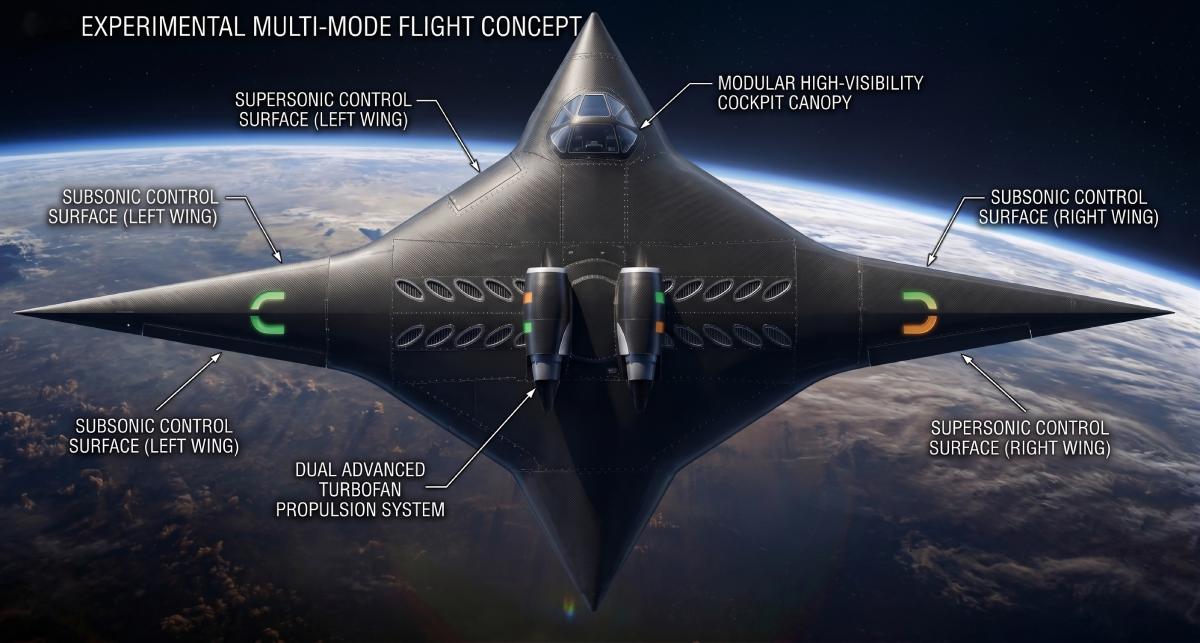
SBiDir is a Flying Wing (FW) configuration from the parametric analytical study published by the team lead by Prof. Gecheng Zha at University of Miami that focuses on high aerodynamic efficiency and low sonic boom. The SBiDir-FW completely throws out the traditional tube-and-wing playbook.
The concept is wildly unorthodox but mathematically brilliant! You build a flying wing that is perfectly symmetrical on both its longitudinal and lateral axes.
Take off and landing at subsonic speeds (M<1)
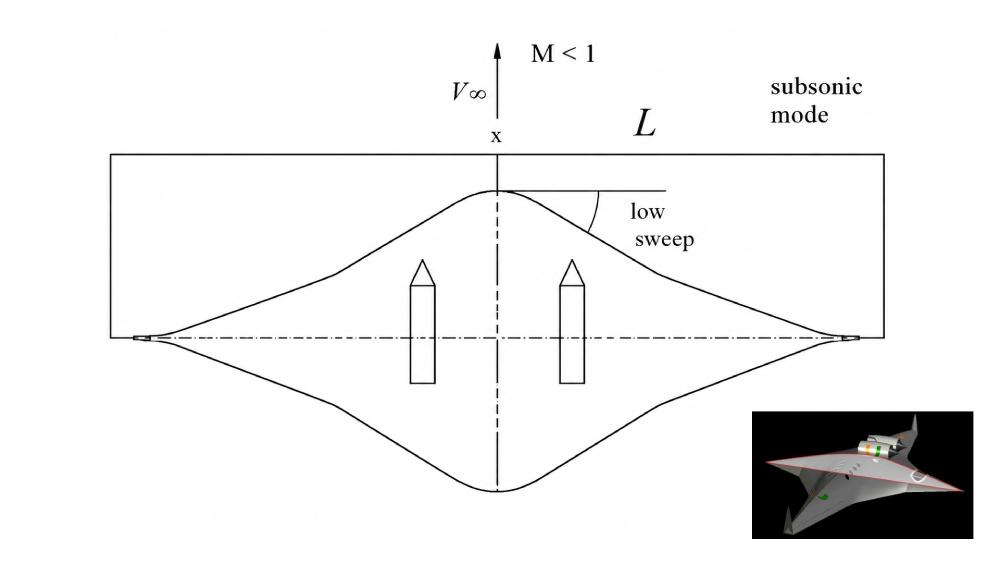
When it takes off or lands, the configuration flies in a horizontal way. This gives the plane a massive wingspan required for a quiet, highly efficient, low-speed climb. Like a glider.
Cruise at supersonic speed (M>1)
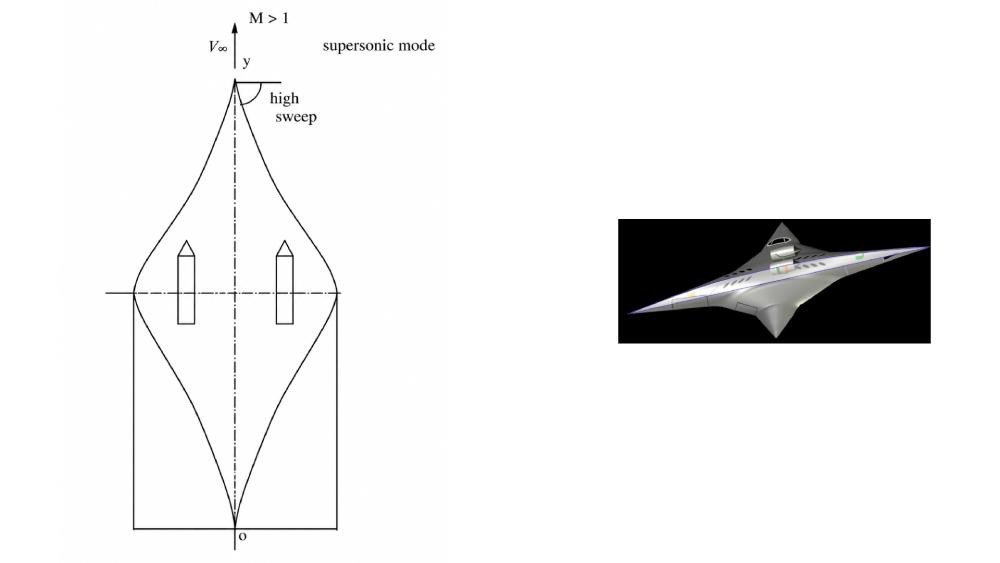
Then, when the aircraft hits high subsonic speeds (around Mach 0.8), the entire airframe rotates 90 degrees around its vertical axis like a giant flying frisbee. The winglets would straighten and the long wings become the nose and the tail of the airplane. The previous nose and tail would become short, highly swept wings. It’s almost as if, suddenly, the efficient low-speed glider has shape-shifted into a high-speed supersonic aircraft.
Here’s a video on the same:
How strong does the data hold?
The numbers behind this concept are genuinely staggering. The paper shows that the CFD (Computational Fluid Dynamics) modeling of a 10-passenger SBiDir-FW business jet showed that it achieves a ridiculous lift-to-drag ratio (how much lift an aircraft produces for every unit of drag) of 15 at Mach 1.6, and 16 at Mach 2.0.
To put this in perspective, the Concorde’s lift-to-drag ratio at cruise was roughly 7. The SBiDir-FW is literally twice as aerodynamically efficient than the Concorde.
But the real kicker is the sonic boom. Or rather, the lack of one.
Because of the ultra-slender profile after rotation and a perfectly flat pressure surface, the SBiDir-FW cancels out the downward shockwave. So instead of the deafening N-wave double sonic boom that got supersonic flight banned over land, the SBiDir-FW smooths the acoustic wave out, dropping the peak overpressure drastically.
How practical is the Bi-directional wing design?
If you are worried about your in-flight drink spilling during the 90-degree yaw, don’t be. The proposed rotation in the study states that it could happen aerodynamically using ailerons, requiring no heavy, mechanised rotation gears. The 90 degree rotation itself takes about 3 to 5 seconds. The centrifugal acceleration generated is so minuscule that passengers likely wouldn’t even notice the transition.
So could this be the future?
If the math works, the CFD models verify it, and the concept solves a 70-year-old physics problem, why aren’t we booking tickets on spinning bi-directional flying wings yet?
If I can say, it’s because the modern aerospace industry is terrified.
Building a bidirectional flying wing requires solving brutal engineering headaches. Not to mention coupling the engines so they function across a 90-degree rotation, managing dynamic stability during the transition phase, and designing an entirely new airframe structure.
And then comes the real hurdle – certification! The FAA and aviation giants like Boeing and Airbus are fundamentally risk-averse. They operate on accounting principles, not aerodynamic ambition. It is infinitely cheaper and safer from a corporate liability standpoint to stretch the fuselage of a 1960s-era 737 for the fiftieth time than it is to certify a revolutionary, shape-shifting ninja star.
The supersonic bi-directional wing proves that we have the math to conquer the sky in ways we haven’t even begun to commercialise. To be honest, we aren’t lacking in physics. We are lacking the spine. I would love to see at least a prototype funded out of this study.
First published Aug 31, 2012.
We totally get why you have an ad blocker. If you enjoy reading Geekswipe, turning it off for us helps keep the site alive and the science coming.

Aeronautical engineer, product builder, developer, science fiction author, and an explorer. I'm the creator and editor of Geekswipe. I love writing about physics, aerospace, astronomy, and technology.
More by Karthikeyan KC




is possible this kind of aircraft like SbiDir?????